
Talassar
The Stormbound Sea
A stormbound ocean moon whose rival courts train the Embrace’s most sought-after crews, each court separately aligned with Caelor.
Overview
The Record
Talassar trains the crews the Embrace hires when a route turns dangerous, schooling them on seas rough enough that orbit holds few surprises. Its fortified islands, coastal cities and ocean platforms sit on a storm-wracked moon, where deep seas, strong currents and shifting fronts decide where anyone can live.
No court speaks for the whole world. Island and coastal realms keep their own harbors, laws, fleets and rivalries. They work together through trade agreements, marriages between ruling houses, patrols against pirates, or a shared storm, and go their own ways when the need ends. What they share is a profession, not a constitution: captains, shipwrights, weather-readers and boarding crews trained in water hard enough to punish every shortcut.
The courts turned outward one at a time. Each contracted separately with Caelor for wider lanes, charts and protection. In the end Talassar was an allied confederation in Caelor’s sphere without ever having formed a confederation of its own. Caelor’s authority reaches the outside relationship. It does not let one of Talassar’s courts command another.
Both aspects of the Twofold belong aboard the same voyage. Summoners find routes when storms hide a coast or currents make a chart useless. Dawn governs rescue, rebuilding and safe return. Gloam governs the long watch, hidden passages, and enduring what cannot be known. Crews use whichever practice the sea calls for, and do not treat balance as a doctrine.
Talassar’s skill travels farther than its politics. Its people crew ships across the Embrace and the Far Reach. Meanwhile storms routinely close its own harbors, and divided authority keeps the moon from directing that labor as one power. Talassar can train a captain for the hardest route in the system. Nobody there can promise when that captain’s home port will reopen.
Political Relationships
Standing
Standing at a Glance
- Political Status
- Allied Confederation
- Civilization Status
- Major Civilization
- Heraldic Standing
- Collective Seal
- Principal Power
- Caelor
Talassar is an allied confederation in Caelor’s sphere, but its own courts are not confederated with one another. Island and coastal realms keep their harbors, laws, fleets and internal sovereignty. No single court can bind the moon.
Each court contracted separately with Caelor for wider lanes, charts and protection, and for a partner abroad able to answer for a whole sea. Together the agreements give Talassar an outward alignment. They give Caelor no authority to let one of Talassar’s realms command another.
Avarra remains Talassar’s maritime client league. Its city-states govern themselves, and Talassar supplies charts, warning, defense and wider access in return for navigators and service with the fleet. Talassar’s collective mark stands for that outward alignment, not for a central government over its courts.
Locations
Locations on Talassar
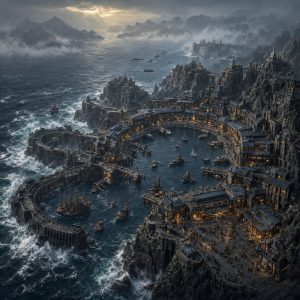
City
Lyrassa
Talassar’s largest fortified harbor city, receiving orbital and ocean traffic behind layered storm walls and ruling no court beyond its own waters.
View location →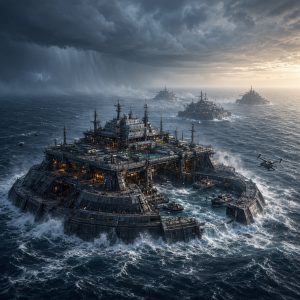
Infrastructure
The Greywake Stations
The Greywake Stations keep watch over Talassar’s storm belt, turning deep-ocean observations into trained pilots, route warnings and rescue launches, and into refuge.
View location →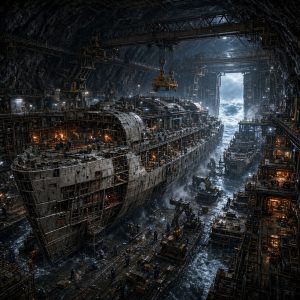
Fortress
Blackreef Yards
A fortified volcanic-reef shipyard that builds storm-hardened vessels and close-defense escorts for one of Talassar’s courts, for fleets from Avarra and for foreign buyers.
View location →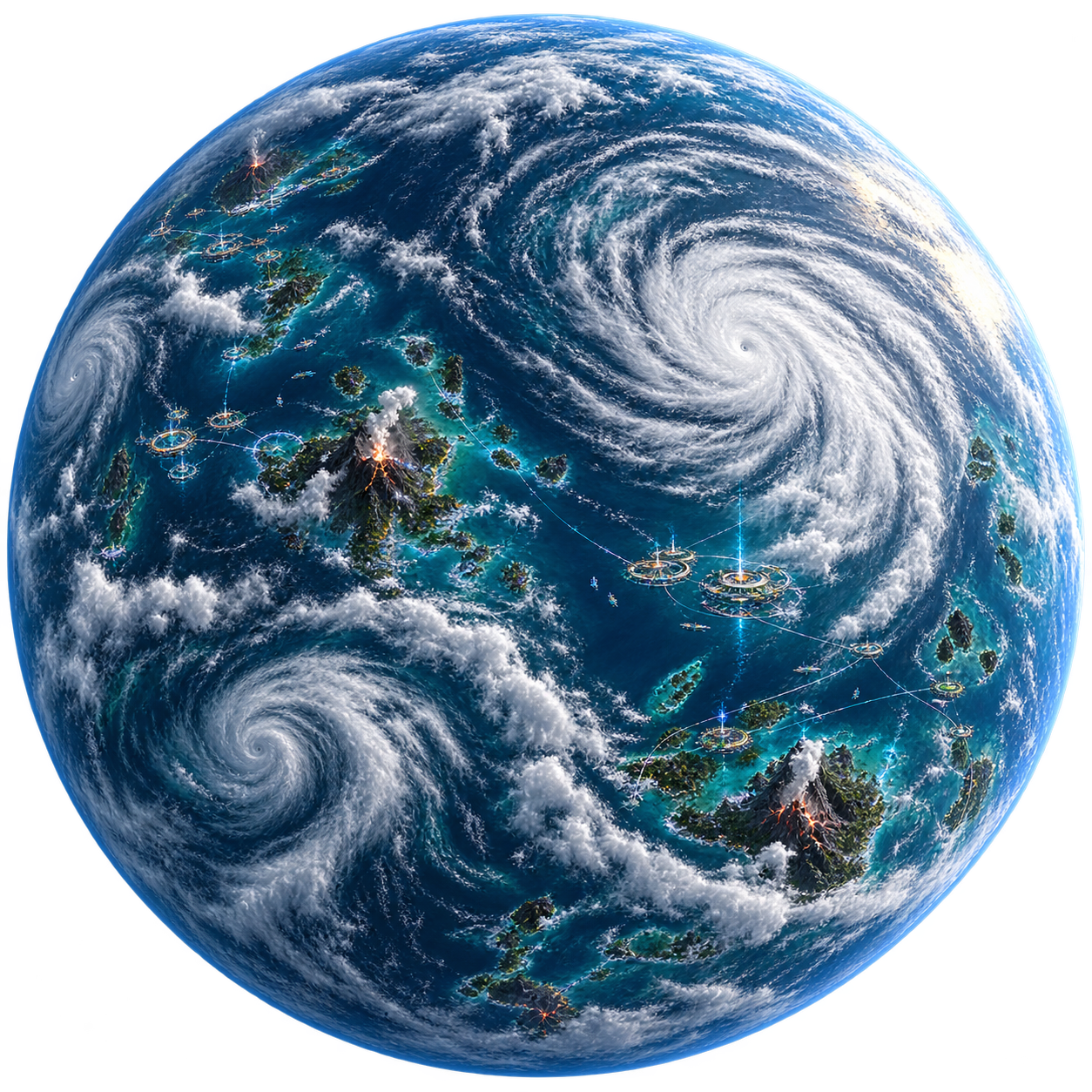
Physical Characteristics
Ground and Sky
- Diameter8,300 km
- Mass0.3 Earth masses
- Gravity0.71 g
Talassar’s air is thick, humid and breathable, over deep global seas, volcanic islands, shallow shelves and scattered highlands. Warm and cold currents drive storm belts, heavy rain, and waves that can redraw a coast. Salt, damp, flooding and wind are constant threats to anything built, so harbors and ordinary houses are engineered against water before anything else.
Orbit and Time
Path Around Oranth
- Orbital Order250
- Orbital Radius3,350,000 km
- Orbital Period22.872 days
- Rotation548.93 hours
- Inclination0.38 degrees
- Eccentricity0.012
Talassar is tidally locked to Oranth and turns once in each 22.872-standard-day orbit. Its starrise-to-starrise cycle runs about 24.2 standard days, roughly twelve days of light and twelve of dark. The deep oceans even out the temperature, while the moving edge of the light drives steady winds, changing currents and storms that form on a predictable schedule. Harbors publish eclipse and weather tables for fishing, repair and departures.
Culture
The Twofold
Crews on Talassar use both aspects in a single voyage. Summoners find routes when storms hide coasts, reefs shift, or currents make a chart useless. Dawn governs rescue, rebuilding, preparation and safe return. Gloam governs long watches, fog passages, concealment, and enduring what cannot be known. Practice is judged by whether the ship comes home, not by doctrine.
Travel
Travel Notes
Route through a weather-monitoring station before descent and accept the coastal port you are assigned. Descent is refused when the receiving harbor cannot keep an approach open. Talassar adopted Descent Law early, because its courts already trusted the custom of harbor pilots. The receiving court’s descent pilot boards in orbit, takes the helm before its helm line and holds it to landing, and the ship’s crew keeps off the controls below it. That pilot’s charge ends at landing. Travel between islands usually needs a separate local pilot, and a berth in one court’s harbor gives no right to enter another’s. Storm closures can hold ships for days, so a schedule is an intention, not a guarantee. Under the Binding, outer escorts are crewed against boarding, not against attack at range. Confirm harbor law, quarantine and the receiving court before you leave.